5 Steps to Introduce Stage-Gate Thinking to Your Engineering Team
Mar 8, 2026 · 4 min read ·Career & Leadership
Most engineering teams already make go/no-go decisions — they just don't have a name for the process. Robert G. Cooper's Stage-Gate framework, originally designed for physical product development, gives you that name and a structure to make those decisions consistently. Here's how I'd introduce it to a team that's never heard of it.
Learn What Cooper Actually Proposed
In the 1980s, Robert Cooper studied why product launches failed and found a pattern: teams that separated "doing the work" from "deciding whether to continue" shipped better products. He called the work phases stages and the decision checkpoints gates — and the Stage-Gate process was born. It's not a project management methodology or an alternative to Agile. It's a decision-making framework that sits above however your team builds.
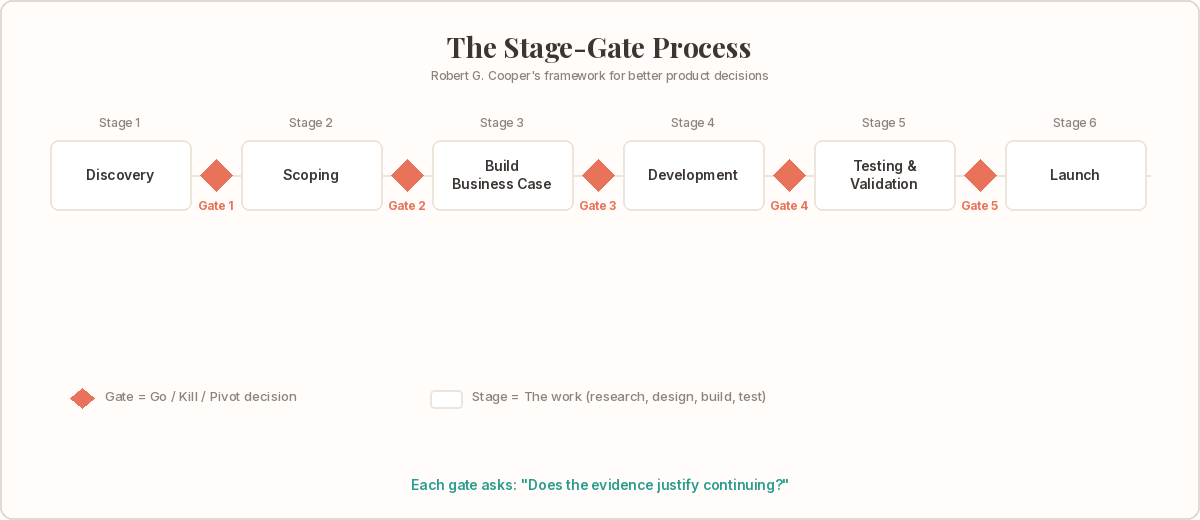
Map Gates to the Decisions You Already Make
Your team likely already has moments where someone decides whether to keep going: a design review before building, a stakeholder check-in before launch, a "should we even do this?" conversation in a planning meeting. Stage-Gate doesn't ask you to invent new checkpoints — it asks you to recognize the ones you already have and make them intentional. Write down the last three projects your team shipped and mark the moments where direction actually changed or got confirmed.
Separate the Stages from the Gates
This is Cooper's core insight and the one engineers miss most often. A stage is the work — research, design, coding, testing. A gate is the decision about whether that work justifies moving forward. Teams that blur these two end up in a mode where momentum replaces judgment: the project continues simply because effort has been invested. Naming the gate as a distinct event forces a genuine pause.
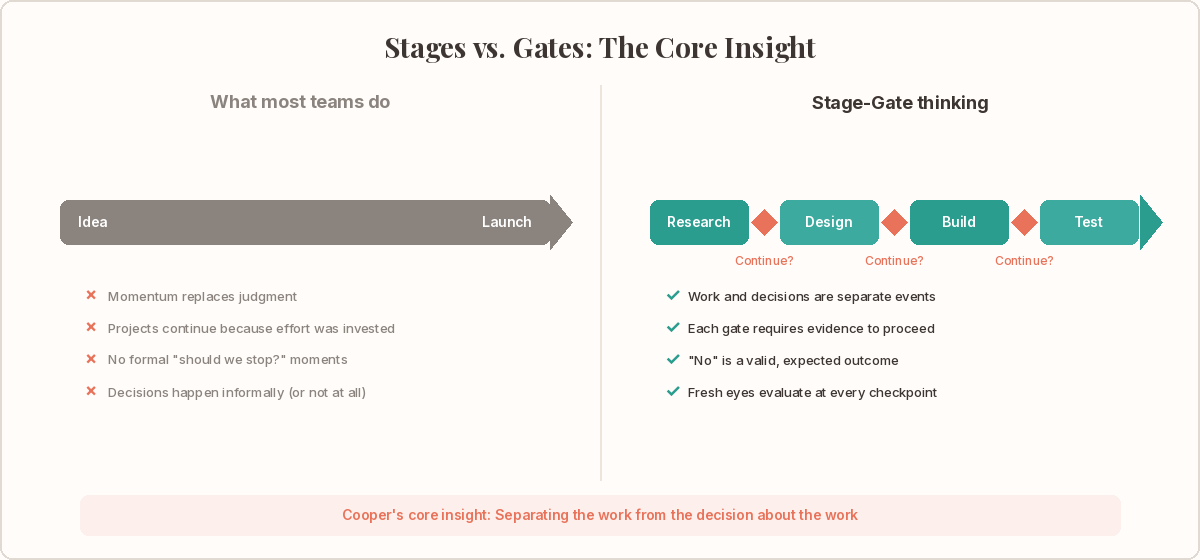
Assign Gate Owners Who Can Say No
A gate without someone who can kill the project is just a status meeting. Cooper was explicit about this: each gate needs a gatekeeper — a person or small group with the authority to say "stop." In engineering organizations, this is often a director or VP for larger bets, or a tech lead for smaller ones. The key is that the gatekeeper wasn't the one doing the work in the previous stage — fresh eyes make better kill decisions.
Start with One Gate, Not Five
Cooper's full framework has five stages and five gates. You don't need all of them on day one. Pick the transition where your team has the most regret — the point where you most often say "we should have caught this earlier" — and formalize just that one gate. Define what evidence is needed to pass it, who makes the call, and what "no" looks like. Once that gate is working, add the next one.
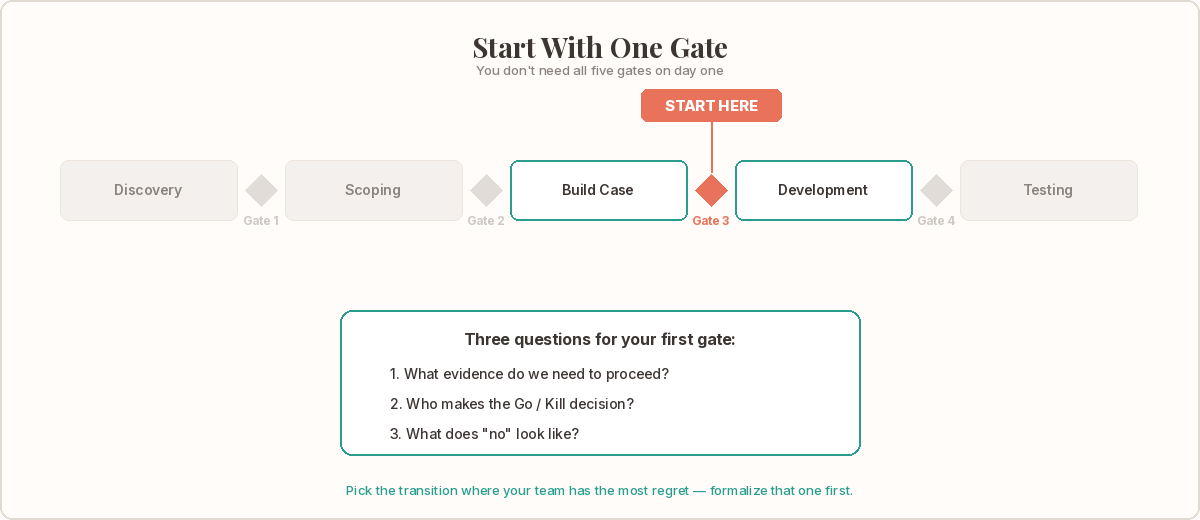
The beauty of Stage-Gate is that it doesn't compete with how your team already works — it puts a frame around the decisions you're already making and gives you permission to stop projects that aren't earning their next stage.
Enjoyed this? There's more every Friday.
One idea, five practical steps. Engineering leadership, architecture decisions, and AI tooling you can use today.
Join 100+ readers.
Subscribe — it's free