5 Steps to Build a Second Brain That Survives Being Ignored
Aug 24, 2026 · 5 min read ·Career & Leadership
You wouldn’t ship a system that only stays healthy while someone watches it. Engineers have a name for that — an operator dependency — and designing it out is the job.
Yet that’s what almost every personal knowledge system is. Notes apps, wikis, vaults — they work beautifully in week one, run by the most attentive version of you. Then a launch lands, or you travel. Three weeks later the inbox has two hundred items, the folder tree you built in month one no longer matches how you think, and opening the thing feels like opening someone else’s desk.
So this time I started from one constraint, written down before any feature: it has to survive three weeks of neglect. Everything below fell out of that sentence.
The system that came out of it is called Cairn — and one disclosure before you read on: none of it is built yet. What follows is the design — v0.1, argued through and written down, but not a line of it running. Where you see terminal output below, that’s the shape I’m building toward, not a screenshot of something working. I’m publishing the reasoning first on purpose. It’s the part that gets quietly rewritten once code exists and nobody can remember what was decided, or why.
Design Against the Failure Mode, Not the Feature List
Feature lists are optimistic by nature. They describe the system on its best day, run by its most diligent user. A failure mode is the opposite — it’s testable. I can stop touching the thing and see what breaks. So every proposal now meets one question first: does this still work if I ignore it for a month? It rejects far more than it approves. A folder tree under my notes — wrong within six months. A staging area for drafts — the inbox already is one. Opaque note IDs — I read these filenames, so they should read like sentences. Tiered privacy levels — in practice, exactly one on-off switch ever gets used.
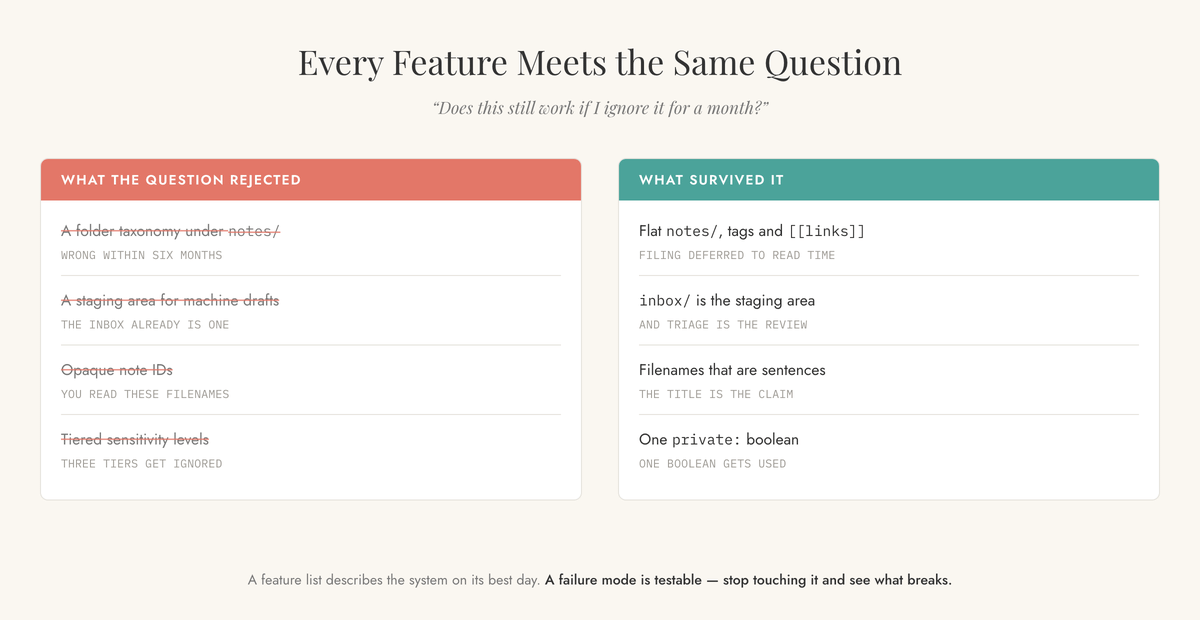
Eight proposals, one question. It rejects far more than it approves.
Move the Decision to When You Can Actually Make It
Capture should take zero decisions. Drop a file, send something from your phone, run a command — none of them ask you to name, file, or tag anything. That friction, at that exact moment, is why things never get captured: you’re mid-meeting and the system stops to ask which folder. The filing still happens. Just once, later, at triage. And the wider point has nothing to do with notes. Most systems people quietly abandon are asking for a decision at the exact moment you have the least attention to give.
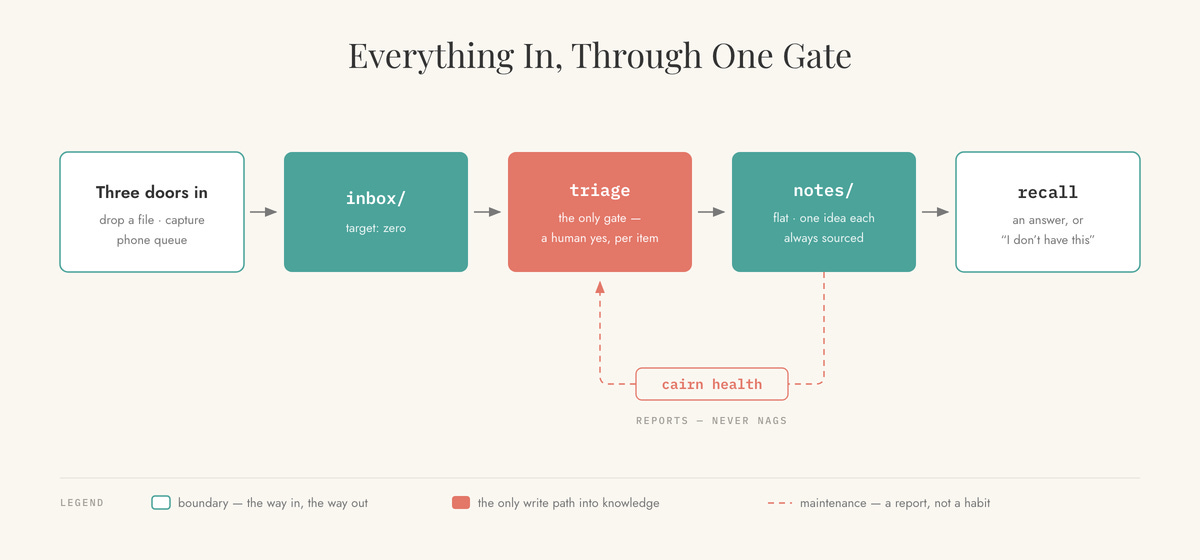
One way in, one gate, one way out. The dashed line is the part most systems don’t have.
Count Your Write Paths — There Should Be One
Every tool that can touch the vault has to declare what it’s allowed to change, before it gets built. A reader writes only to throwaway output. A recorder appends only to today’s log. A curator is the only one that can write into my actual notes — and it has to ask, every single item. That turns a good intention into something I can count. I’m not promising to review everything that enters my notes; I can check it by counting the ways in. There is exactly one. Here’s the part that sounds harsh and isn’t: nothing a machine wrote is trusted on its own. Software proposes. I accept, or I don’t. And “just tidying up” still counts as writing into knowledge.
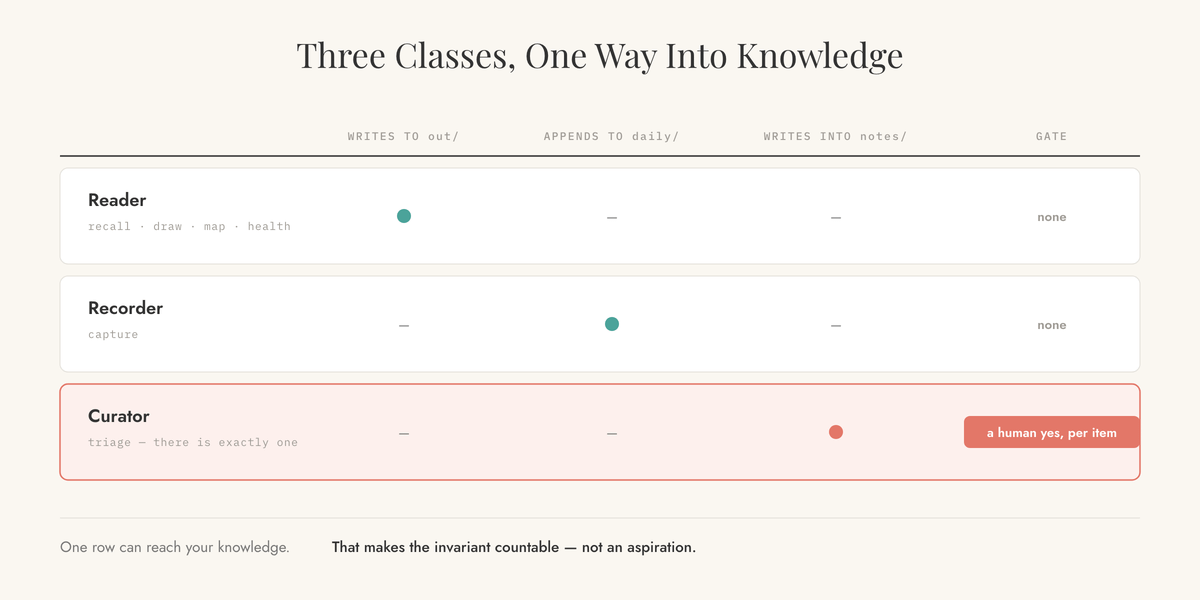
Three classes. Only one can reach your notes — and it has to ask, every time.
Pick a Substrate That Outlives the Tool
Markdown files. Git. Full-text search. Seven folders, flat where it counts. The rule is that no tool is load-bearing. The check is a substitution test: if the app I read these files with vanished tomorrow, nothing becomes unreadable — only less convenient. Flat matters for the same reason. A deep folder tree forces you to classify something the moment you write it, using a filing system you invented before you understood what you’d be filing. Flat plus good search fails gracefully; a wrong tree just gets more wrong. And machinery only arrives once you’ve watched the simple thing fail. Plain text search first, and mean it.
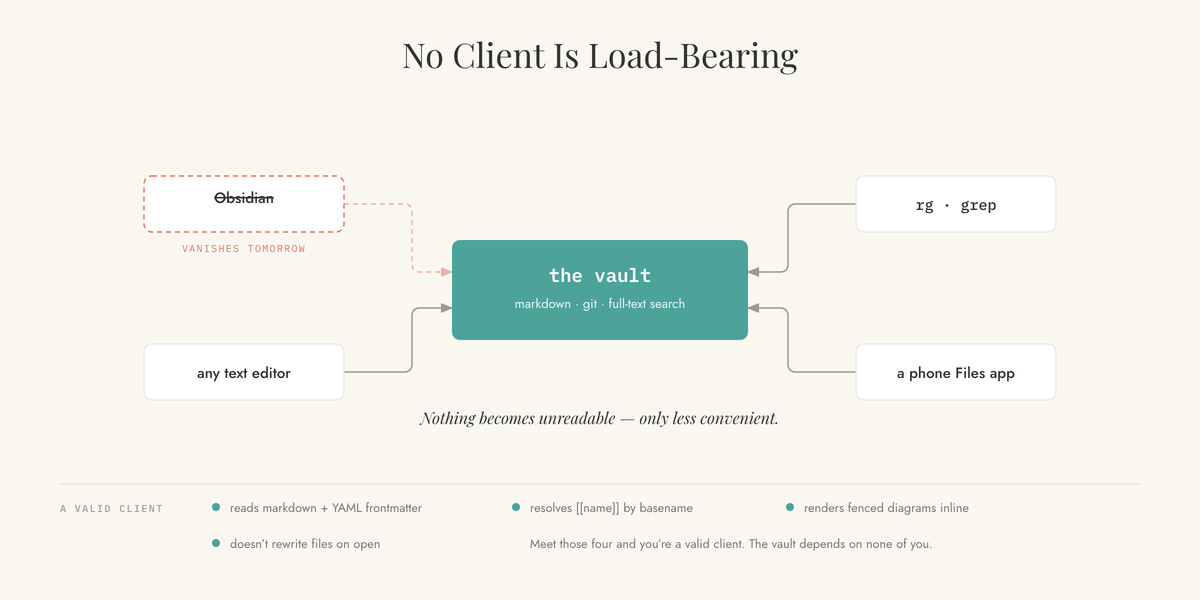
The substitution test: take any app away and the files are unchanged.
Replace Discipline with a Report
“Prune, dedupe, improve links” as a weekly habit gets abandoned by month three. Every time. So the maintenance isn’t a habit at all — it’s a command that reports. Clearing it is an evening’s work, not a standing obligation you’ll feel guilty about. One of those lines counts private notes that have left this machine, and the correct number is zero. That isn’t discipline I have to sustain; it’s a number I can read. Anything that only holds while you’re diligent isn’t a property of the system, it’s a property of your week.
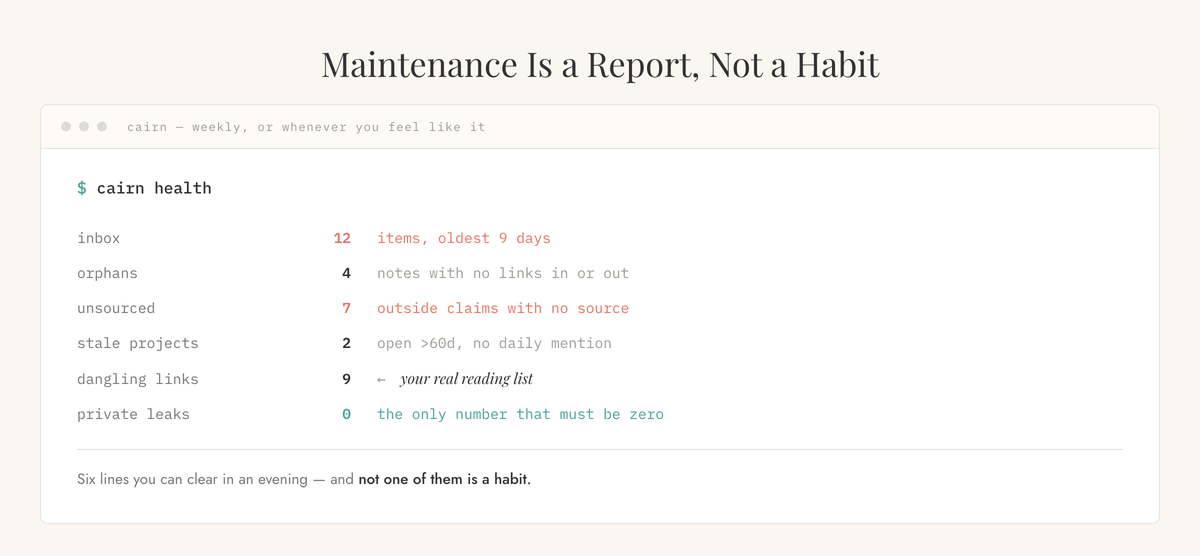
Dangling links, it turns out, are just your real reading list.
There’s one rule the other five exist to protect. When a search turns up nothing that clears the bar, the answer is “I don’t have this” — never a plausible answer dressed up as memory. Everything else in a vault you can check by eye. Retrieval you can’t, because its failure mode is an answer that looks fine. Once you can’t tell which answers are yours and which ones a model produced for you in a hurry, none of them are worth having.
That rule is also the one claim on this page I can’t yet check. So before I build the search, I’m writing down about fifteen questions and the notes that should come back for each. A golden set, recorded while I still remember what’s in there. When those answers start drifting, retrieval is rotting — and I’d rather learn that from a failing test than from a year of answers that were quietly a bit wrong.
The full wall chart is below — the whole design on one page. Some of it won’t survive contact with the build, and I’ll say so when it doesn’t. Next Friday: capture — three doors in, and why the phone gets exactly one job.
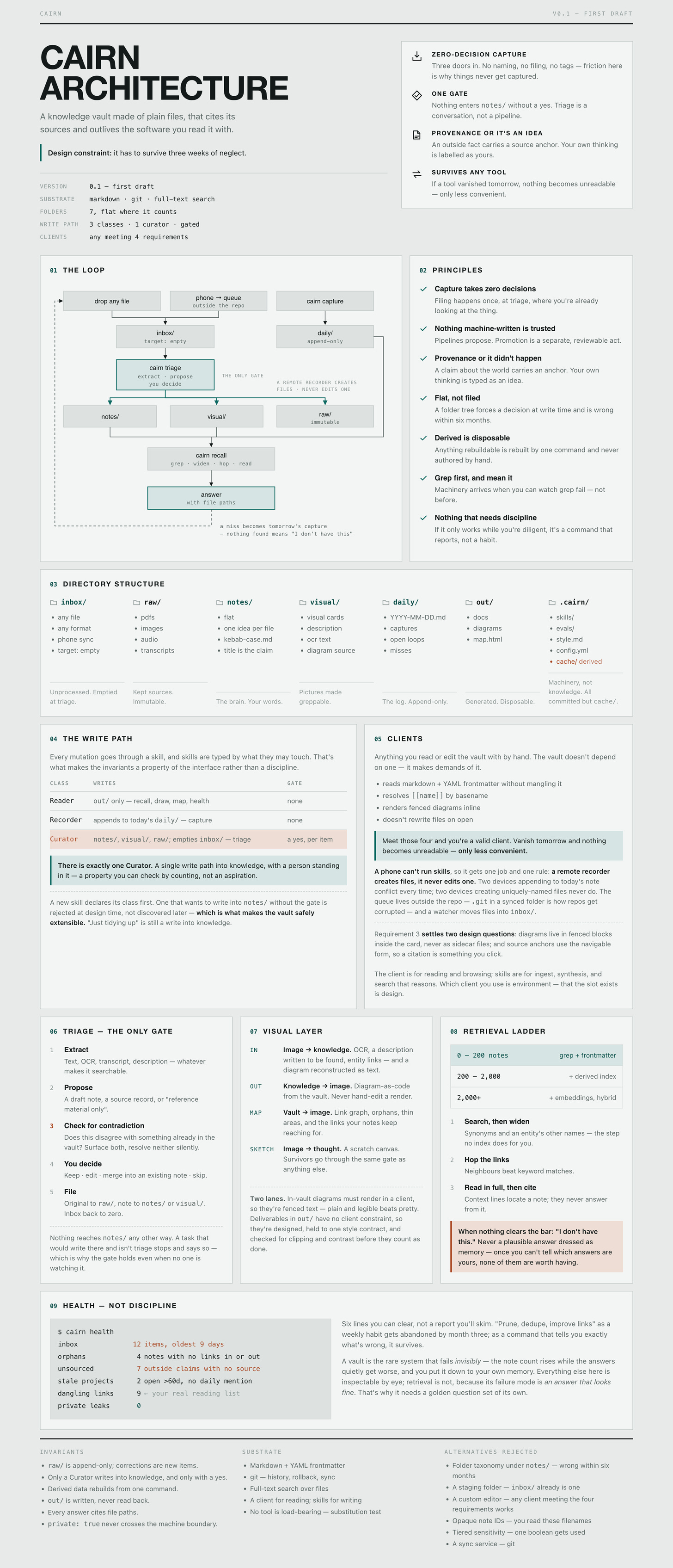
Cairn v0.1 — the whole design on one page. Click to open full size.
Enjoyed this? There's more every Friday.
One idea, five practical steps. Engineering leadership, architecture decisions, and AI tooling you can use today.
Join 100+ readers.
Subscribe — it's free